

Quick Answer
What are multifocal lenses, and who are they suitable for? Multifocal lenses, also called progressive lenses, are glasses that provide clear vision at all distances, near, intermediate and far, without the visible lines found in bifocals. They work by smoothly blending multiple prescriptions into a single lens, allowing the wearer to shift focus naturally between tasks such as reading, computer work, and driving. Multifocal lenses are ideal for people over 40 experiencing presbyopia, a common age-related change in near vision, and for anyone who wants the convenience of a single pair of glasses for all daily activities.
Do you find yourself constantly switching between different pairs of glasses? One for reading, another for driving, and maybe a third for the computer? It can be frustrating and inconvenient. If you’re over 40, you might be noticing that your near vision isn’t what it used to be, a common age-related condition called presbyopia.
There’s a modern solution that offers incredible convenience – multifocal lenses. These advanced lenses provide clear vision at all distances in a single pair of glasses, eliminating the need for daily juggling. This guide offers expert advice on what multifocal lenses are, their benefits, and how to choose the right pair for your lifestyle.
What Are Multifocal Lenses and How Do They Work?
Multifocal lenses, also known as progressive lenses, are a marvel of optical technology. They seamlessly combine multiple prescriptions into a single lens without any visible lines. This allows you to see clearly whether you’re looking at something up close, far away, or in between.
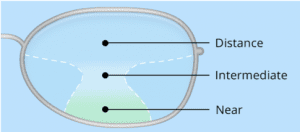
Imagine the lens is divided into different zones that you naturally look through depending on your focus:
- Top Portion – This area is designed for distance vision. It’s what you use when driving, watching TV, or looking across the room.
- Middle Portion – The intermediate zone is ideal for tasks that require close visual attention, such as computer work or viewing items at arm’s length, like your car’s dashboard or products on a supermarket shelf.
- Bottom Portion – This is the reading zone, providing the magnification you need for close-up tasks like reading a book, checking your phone, or viewing a menu.
The transition between these zones is gradual, or “progressive,” allowing your eyes to move smoothly from one distance to another. It’s a tailor-made solution that provides a much more natural viewing experience compared to older lens types.
Multifocal Lenses vs. Bifocal Lenses
It’s easy to confuse multifocal and bifocal lenses, but they offer very different experiences. The main distinction lies in their design and functionality.
Bifocal Lenses
Bifocals have only two prescriptions: one for distance and one for near vision. These two zones are separated by a distinct, visible line across the lens. While functional, this design has a major drawback – it offers no correction for intermediate vision. This creates an “image jump” as your eyes move across the line, making computer use or looking at objects at arm’s length difficult.
Multifocal Lenses
Multifocals provide a full range of vision – distance, intermediate, and near, all in one seamless lens. There are no distracting lines, which offers a better cosmetic appearance. More importantly, the smooth transition between prescriptions provides a more natural and comfortable visual experience, accommodating the dynamic needs of a modern lifestyle.
| Feature | Multifocal Lenses | Bifocal Lenses |
| Prescriptions | Multiple (Distance, Intermediate, Near) | Two (Distance, Near) |
| Visible Line | No | Yes |
| Intermediate Vision | Yes | No |
| Visual Experience | Smooth, natural transitions | Abrupt “image jump” |
The Benefits and Common Concerns of Multifocal Lenses
Like any technology, multifocal lenses come with a set of pros and cons. Understanding them can help you decide if they’re the right choice for you.
Key Benefits
- Convenience: This is the most significant advantage. You only need one pair of glasses for everything, from driving around Sydney to reading a text message, no more switching glasses.
- Natural Vision: The progressive design mimics natural vision more closely than bifocals or trifocals.
- No Distracting Lines: The seamless look is more aesthetically pleasing and avoids the “old-fashioned” appearance of bifocals.
- Full Range of Focus: They provide clear vision for every distance, making them ideal for dynamic activities like shopping, presenting at work, or socialising.
Common Concerns
- Peripheral Distortion – The edges of multifocal lenses can have some distortion or blurriness. This is a normal part of the lens design, but modern digital lenses have significantly minimised this effect.
- Adaptation Period – It may take some time to adjust to multifocal lenses. Some people adapt in a day, while others may need a few weeks.
- Cost – Because they involve more advanced technology, multifocal lenses are generally more expensive than single-vision or bifocal lenses.
Tips for Adjusting to Your New Multifocal Lenses
Adjusting to multifocals is a process of teaching your brain to use the new lenses effectively. Here are a few tips to make the transition smoother:
Wear Them Consistently
The best way to adapt is to wear your new glasses full-time. Avoid switching back to your old pairs, as this can confuse your brain.
Point Your Nose
Instead of just moving your eyes, get into the habit of pointing your nose directly at what you want to see clearly. This helps align your eyes with the correct part of the lens.
Move Your Head
When reading, move your head slightly from side to side to follow the text, rather than just your eyes. This keeps you in the clear reading corridor of the lens.
Be Patient
Give yourself time. Your brain is learning a new skill. If you’re still struggling after a couple of weeks, let your optometrist know. A small frame adjustment can often make a big difference.
Get Expert Advice on Your Vision
Navigating the world of optical lenses can be confusing, but you don’t have to do it alone. A comprehensive eye exam is the first step toward finding the perfect solution for your vision and lifestyle. Our team is dedicated to providing personalised care and expert advice.
Ready to experience the convenience of clear vision at every distance? Book an appointment with our friendly optometrists in Double Bay. Call us on 9362-9944 or book easily online today.
Frequently Asked Questions (FAQs)
Are multifocal lenses worth it?
For most people experiencing presbyopia, the answer is a resounding yes. The convenience of having clear vision at all distances in a single pair of glasses significantly improves the quality of life. Although there is an initial investment and adaptation period, the long-term benefits are well worth it for an active and modern lifestyle.
How do I choose the right multifocal lenses?
Choosing the right lenses depends on your prescription, lifestyle, and budget. Our optometrists at The Eye Scene in Double Bay will conduct a thorough eye exam and discuss your daily activities to recommend the best lens design for you. Factors such as your occupation, hobbies, and the amount of time you spend on digital devices will all be taken into consideration.
Can multifocal lenses be used for myopia in children?
Yes, specific types of multifocal lenses are now a key strategy in controlling the progression of short-sightedness (myopia) in children. These lenses work differently from those for presbyopia but are proving to be an effective tool in myopia management.